

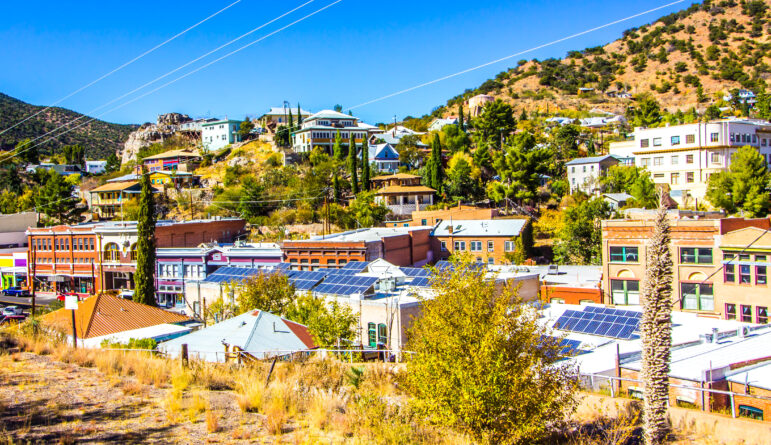
Nestled in the Mule Mountains just eight miles north of the Mexican border, Bisbee feels like no other town in Arizona. Once one of the richest mining camps in the West, it has reinvented itself as a haven for artists, dreamers, and travelers seeking a touch of eccentric charm. Bisbee’s story is a study in transformation from the roar of dynamite to the quiet hum of creativity.
In 1877, a U.S. Army scout stumbled upon copper ore in the Mule Mountains, and soon the hills echoed with the sound of drills and dynamite. Within a decade, Bisbee became one of the most productive mining towns in America, yielding millions in copper, gold, and silver. The mines drew workers from across the globe Irish, Mexican, Serbian, Cornish creating a rare cultural mix for the time.
At its peak, Bisbee thrived with opera houses, electric lights, and one of the first public libraries in the territory. It was a cosmopolitan outpost in the desert and, like many mining towns, it lived fast. When the veins ran dry, the economy faltered. By the mid-20th century, Bisbee was on the brink of becoming another ghost town swallowed by dust.
But Bisbee refused to fade. In the 1970s, artists, musicians, and free spirits from across the country arrived, drawn by cheap rents and the haunting beauty of its Victorian buildings. They saw potential where others saw decay. Galleries opened in old saloons, coffeehouses filled the narrow alleys, and color returned to the canyon walls.
Today, that creative pulse still defines Bisbee. Murals spill across brick walls, local art lines the streets, and a bohemian energy flows through the town’s winding stairways and steep lanes. The transformation isn’t just aesthetic, it’s soulful. Bisbee is a place where reinvention feels as natural as the desert sunrise.
Bisbee’s architecture tells its story in layers. The lower district, known as Brewery Gulch, once hosted the town’s wildest saloons and brothels. Now it’s home to cozy cafés, live music venues, and vintage boutiques. Climb the narrow steps toward the hills and you’ll find elegant turn-of-the-century homes with sweeping views of the valley below.
For a literal descent into the past, the Queen Mine Tour takes visitors 1,500 feet underground. Led by retired miners, it’s a gripping look at the harsh realities of early 20th-century labor: the noise, the danger, and the skill it took to wrestle ore from solid rock. Emerging into the sunlight afterward, you can’t help but feel awe for the endurance that built this town.
Modern Bisbee balances old bones with fresh perspective. Its narrow streets buzz with creative energy but remain anchored in heritage. Local restaurants blend Southwestern flavors with global twists, while boutique hotels occupy restored mansions. The town’s calendar is filled with quirky events, the Bisbee 1000 stair climb, art walks, and music festivals that turn every corner into a stage.
Yet even amid the color and laughter, Bisbee keeps a touch of melancholy. Its weathered facades and rust-red hills remind visitors that time never stands still; it simply changes form. In Bisbee, history doesn’t fade; it evolves.
To visit Bisbee is to feel the intersection of grit and grace. It’s where miners’ tunnels and artists’ studios coexist, where hardship gave way to harmony, and where the Old West spirit found new expression in art and imagination.
Whether you’re sipping coffee on Brewery Gulch, wandering through an art gallery, or watching the sunset spill gold over the mountains, Bisbee leaves an impression that lingers a reminder that even in the desert, creativity blooms where resilience once dug deep.


